
Welcome to your weekly Boomer Women Inspiration Series
Chapter Nine - Wills Uncovered: We've covered a lot with our Boomer Women over two months of exploratory discussions and exercises. But the focus shifts slightly for the next weeks as we get their honest thoughts on specific charity products, brands and communications.
To kick things off, we spent a week discussing legacy options available through charities. We uncovered the key questions they want to know, what moves the dial for them in terms of action, and what their ideal legacy options might look like.
Read on to learn about the fascinating thoughts they shared with us!

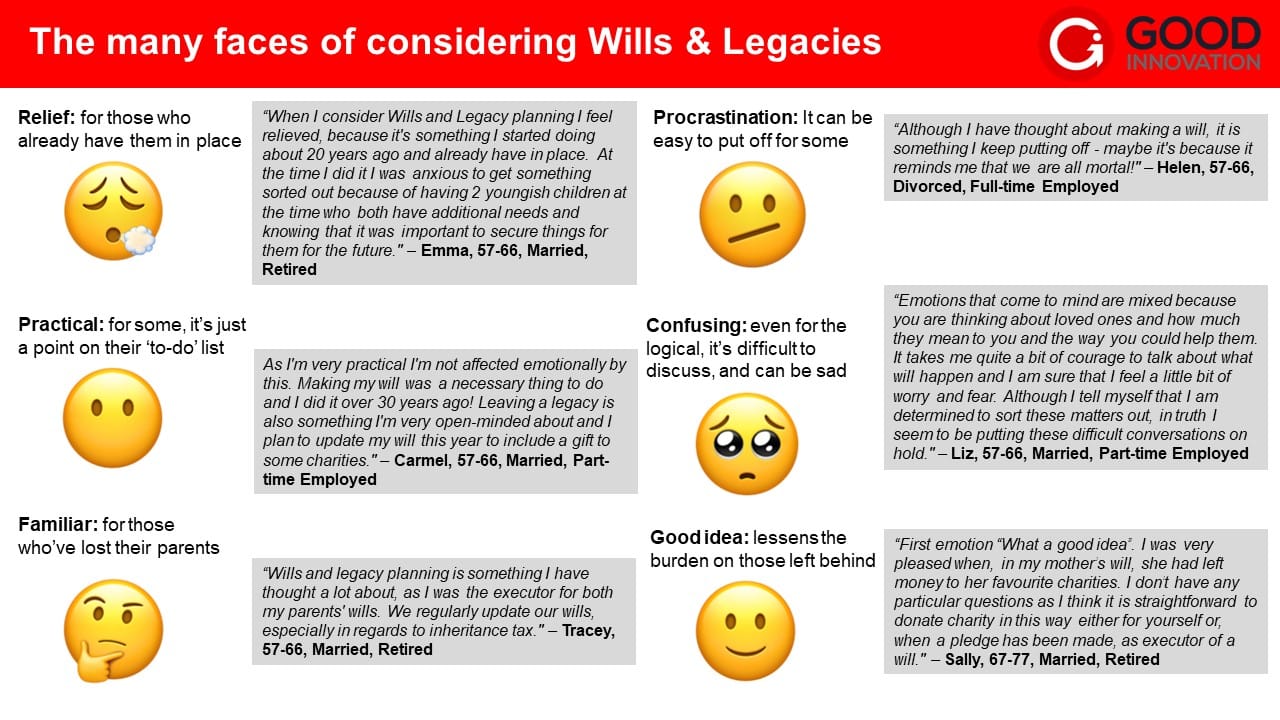
After a frank conversation about Wills and Legacies, we surfaced many different emotions with our Boomer Women. - often influenced by life circumstances. For example, those who've experienced the loss of their own parents, and having to deal with their wills, were more inclined towards being practical and proactive, an outlook shared by those who have their own children. While those without offspring tended to be more likely to have dragged their heels over putting pen to paper to this point.
One thing's for sure; there are a variety of emotions that can come into play: from the highly emotional, to the staidly pragmatic.
Where we saw commonalities was in their attitudes towards how charities might factor into 'being remembered'. Our women place the role of legacy gifting some way down their list when it comes to the impact it might have for them.
For them, they see their legacy as living on through the values and influences they've imparted on the lives of their closest circles - family, friends, peers - rather than through monetary donations necessarily. But they recognise the act itself is one of kindness and 'doing good'.
"I somehow have never linked wills and legacy planning as linked to how I want to be remembered. I think of my legacy as what I leave behind to future generations. For example I believe the way I treat people, the example I show my children and grandchildren and extended family will be my greatest legacy." - Rita, 67-77, Married, Retired
"I'm not thinking of being remembered as such. I will be remembered by my friends and family, that's enough. I have left a legacy." - Catriona, 67-77, Divorced, Retired
"When someone leaves a gift to charity in their will it does reflect on the kindness of that individual. It shows that they think about others. I have not as yet named charities in my will but hope to decide which. Not because I want people to think better of me but to genuinely do some good." - Sally, 67-77, Married, Retired
Charity will writing services hold appeal for some

Those who've recently paid for these services to be carried out by a solicitor can see the benefit of a service like this, and would be happy to donate this fee towards a charity (which they assume is how it works - education on charity impartiality remains important):
"I paid to create my will which I thought was a bit galling. Had someone suggested a way to do it professionally for free, I would have enquired further. I would certainly be happy to donate the fee to charity." - Julia, 57-66, Single, Full-time Employed
"I was interested to learn that charities offer a free will writing service and had I known this I might have considered this option instead of paying a will company to do this. Not necessarily to save money, but to work with the charity and bring me closer to them." -Anne, 57-66, Single, Full-time Employed
But others feel they should be kept separate in order to remove any feelings of guilt, and to ensure there is no bias introduced into what is an important consideration:
"I fully understand the financial struggles that all charities face on a day to day basis, especially at the moment with the cost of living crisis squeezing most peoples disposable income but by doing an independent will, and not one aligned to a charity, I believe I am more in control of how the estate is managed after my death ," - Beryl, 67-77, Married, Retired
But when it comes to considering Gifts in Wills through charities, Boomer Women are seeking reassurance across a few key question areas:
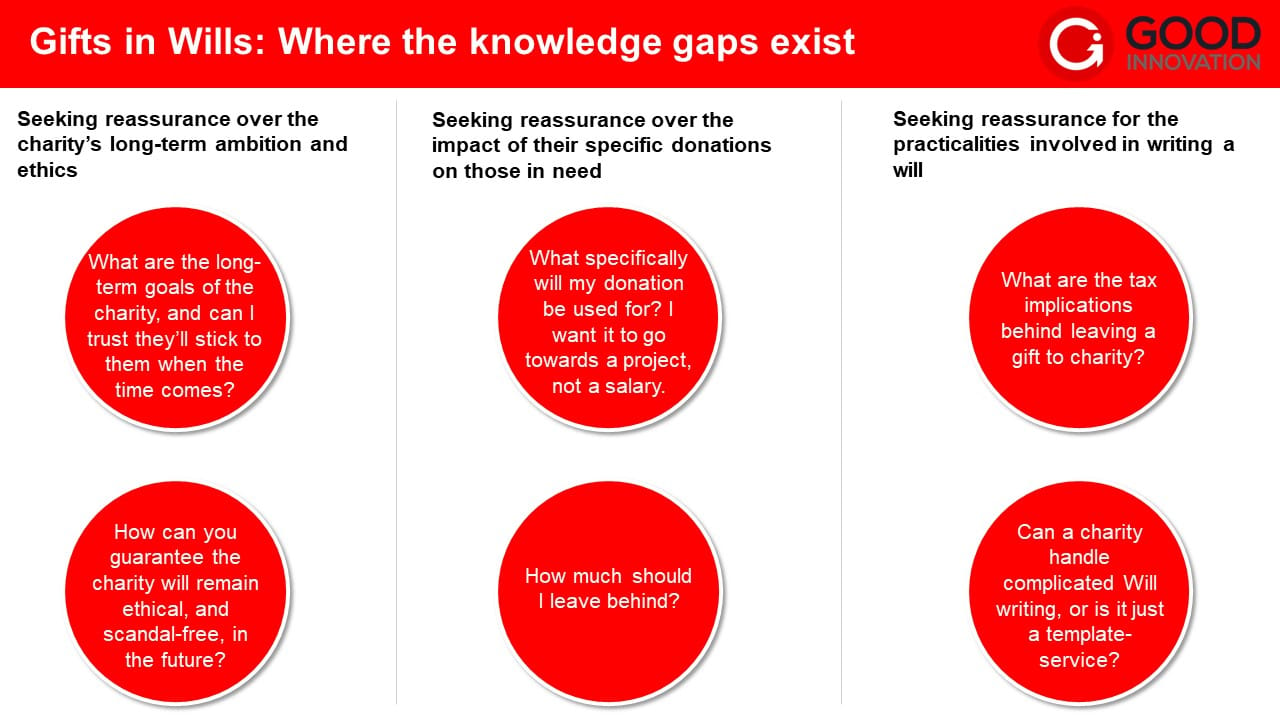
"We should also be aware that charities may change their ethos or ethical concerns may be raised in the future. I would want my children to be able to challenge our bequest, should that occur (however, I'm not sure that is possible)." - Barbara, 67-77, Married, Part-time Employed
"I suppose it would be nice to know how your money that you bequest to charities is going to be used. You may think that one element of the charity is more important than another and you may want your money to be spent on campaigns rather than the general day to day running costs." - Bernadette, 57-66, Married, Retired
"I agree that charities should mention the inheritance tax advantage when promoting leaving a legacy to a charity. Many people want to have as little tax as possible taken off of this unfair tax." - Alison, 67-77, Divorced, Retired
Thought Starter: How might your team start to tackle some of these questions for this audience?
YOUR QUICK FIVE

5 Ways to Promote Gifts in Wills Consideration
As part of our exploration into wills this week, we asked our Boomer Women to create their ultimate top tips to the gifts in wills category. We received a number of different thoughts ranging from tactical guidance, to adopting the right tone of voice through what we've seen can be a difficult topic.
Here are 5 key takeaways to encourage more interest in gifts in wills:
Specify how and where gifts in wills donations will be utilised, providing options where possible: A persistent charity challenge with Boomer Women lies in the perception that too much 'wastage' exists within salary deployment. This fear can raise its head once more when it comes to gifts in wills. They want to know that any future donation will be used to drive a specific project, and have as direct an impact on beneficiaries as possible.
"Charities should make it clear how bequests are used e.g. the Macmillan site says over a third of their work is funded from legacies. They give examples of how their money is used." - Ann, 67-77, Married, Retired
Provide examples of what can be left behind beyond just money: Many of our Boomer Women were pleasantly surprised to be reminded that other valuable items can also be left behind as gifts, such as artwork, furniture and cars.
"The fact that one has the option to leave a valuable item to a charity is extremely useful information. This is something I might take into account when planning." - Sandra, 67-77, Divorced, Part-time Employed
Providing access to in-person community hubs with qualified professionals: As we learnt in our early chapters, Boomer Women value in-person conversations when it comes to complicated topics like finance. Therefore, there is an opportunity to create trust around physical meet-ups in communal spaces with relevant experts.
"I'd want to know that the person doing the work around financial planning is qualified to do so or regulated to give advice. I think the key is to make it as simple as possible to attract people who may want to leave a legacy but are not sure how to do so. Perhaps setting up a hub in a community space with advisers to introduce the idea might work: somewhere people could drop in to to discuss further and then make active plans to make their will might be a good way to 'normalise' this idea." - Kim, 57-66, Divorced, Part-time Employed
Promote the idea of specifying a % as a donation, rather than a specific sum: The idea of including a percentage as a charity donation was one that our women gravitated towards readily as it removes uncertainty in many ways: it protects against inflation, and means a contribution can still be made regardless of what sum is eventually left over.
"I'd not thought of leaving a percentage. It makes sense as how do I know what will be available?!? Think I will alter my will accordingly." - Catriona, 67-77, Divorced, Retired
"The idea of giving a percentage of your estate seems a good idea in encouraging people to leave a bequest. I would imagine that this would increase take up as leaving say 2% would seem negligible." - Brenda, 57-66, Widowed, Part-time Employed
Practical, straight forward tones-of-voice that avoid guilt-laden messaging feel like the best fit: Macmillan and Samaritans were cited as two examples of gifts in will messaging that hits the mark as part of this sensitive discussion. Their language is straight-forward, authentic, respectful and not overly pushy or aggressive at what many acknowledge can be an emotionally taxing time.
"Samaritans (link here) lead with the words 'Support our vital work after you’ve cared for your loved ones'. This is a nice way of asking for money. A couple of other sites use this wording." - Julia, 57-66, Single, Full-time Employed
"The tone charities need to adopt is a compassionate but matter of fact one. There needs to be clarity as to what the money will be used for but particularly if it's something like a cancer charity there needs to be an understanding that the motivation to give may have come through a recent bereavement and may be quite raw." - Liz, 67-77, Widowed, Retired
"The Macmillan charity was brilliant. Lots of really useful information. Wasn't overly emotional. Many charities seem to focus on it being a difficult thing to consider, hard to talk about etc. but this is really straight forward." - Barbara, 67-77, Married, Part-time Employed
Of course, this won’t be all you'll hear on Legacies and Gifts in Wills. Our Opportunity Platforms at the end of the project will have more detailed insights and starter thoughts for innovation for your teams, as part of the Digital Innovation Toolkit.